
A working AI product is not always a production-ready AI platform.
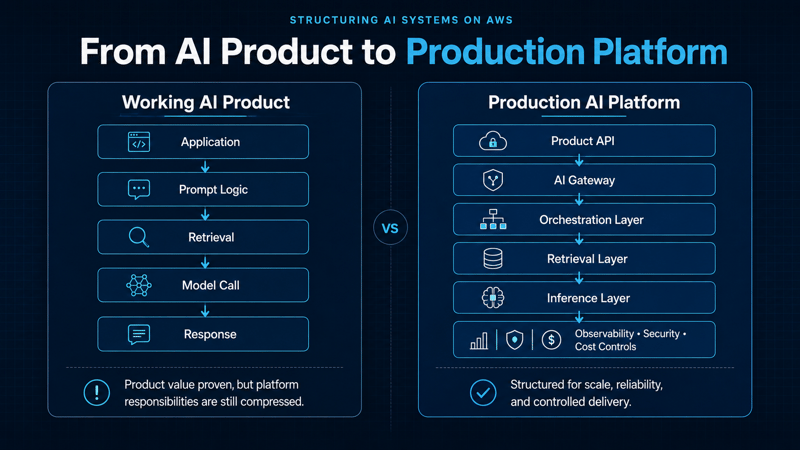
Once the core use case is proven, the next challenge is operating the product at scale. The application may already have users, model integration, prompt logic, retrieval, and a product experience that delivers value.
But as usage grows, the technical challenge changes.
The question is no longer only:
Can we build this AI feature?
It becomes:
Can we operate this AI product reliably, securely, and cost-effectively as the platform scales?
That is where the architecture often needs to mature.
In early builds, AI logic is usually placed close to the product code. Prompt handling, model calls, retrieval, logging, access control, and fallback logic may all sit inside the same application path. This helps teams move quickly at first, but it becomes harder to control as the product grows.
For AI companies building on AWS, the next stage is not usually a full rebuild. More often, it is a structured platform evolution.
That means separating model access, orchestration, RAG pipelines, inference, security, observability, cost controls, and deployment workflows into clear platform layers.
This article is not about building the first AI prototype. It is about the next stage: structuring the AWS platform around an AI product that already works, but now needs to scale, operate reliably, and support controlled delivery.
Why Working AI Products Start to Feel Harder to Operate
The first version of an AI product is often built around speed.
A team needs to validate the use case, test model behaviour, prove the product flow, and show that users can get value from the experience. At that stage, a simple architecture may be enough.
A common early structure places the application, prompt logic, retrieval, model call, and response path close together.
This is useful when the product is still forming.
But once the AI product starts supporting more users, more workflows, more data sources, and more production expectations, this structure becomes difficult to manage.
The same application path may now be responsible for:
- prompt construction
- model selection
- retrieval logic
- access control
- logging and validation
- cost and fallback behaviour
The problem is not that the early architecture was wrong. It served its purpose.
The problem is that the platform responsibilities are now compressed into too few places.
This creates operational risk. A prompt change can affect multiple product flows. A retrieval issue can look like a model quality issue. A model routing change can be difficult to test. Token usage can increase without clear attribution. Security rules can become inconsistent across different AI features.
At this stage, the AI capability needs to move from being a feature inside the product to becoming a structured platform layer around the product.
1. When AI Logic Starts to Outgrow the Application Layer
A production AI platform needs a cleaner separation between product logic and AI platform logic.
The product layer should define what the user is trying to do. The AI platform layer should decide how that request is handled, routed, retrieved, generated, validated, observed, and controlled.
Instead of product services calling models directly from different parts of the application, they should call an internal AI interface through a stable contract.
For example:
task: customer_support_answer
tenant_id: tenant_123
user_role: support_agent
data_scope:
  - product_docs
  - support_tickets
latency_class: interactive
response_format: structured_json
policy_profile: pii_safe_support
This gives the platform more control.
The product team does not need to know every detail of the model route, prompt version, retrieval configuration, guardrail policy, or fallback path. Those responsibilities can sit behind the AI platform layer.
This structure also makes AI features easier to operate. Teams can improve the model route, change retrieval logic, introduce stricter policies, or adjust observability without rewriting the product experience.
For AI companies that already have a working product, this is often the first architectural shift that makes the platform more manageable.
2. Centralise Model Access Before It Spreads Across the Product
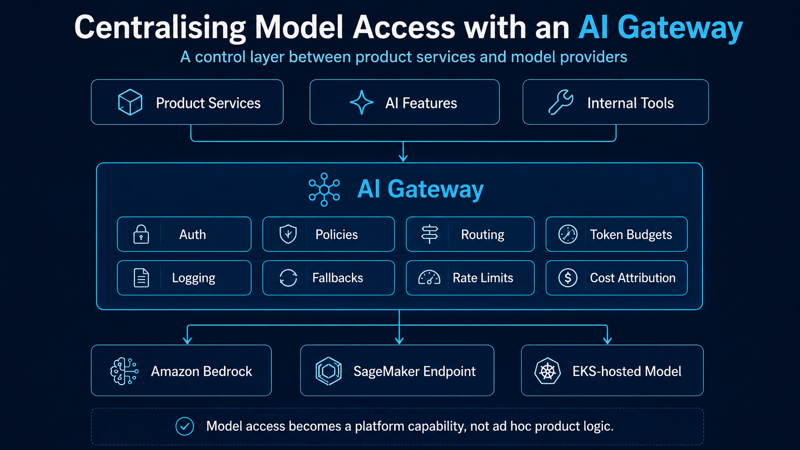
One product feature may call Amazon Bedrock. Another may call a SageMaker endpoint. Another may use a third-party model API. Another may call a self-hosted model running on Kubernetes.
A better pattern is to centralise model access through an AI gateway.
Fast path → lower latency, lower cost
Complex path → stronger reasoning capability
Batch path → asynchronous processing
Fallback path → backup model or degraded response
Restricted path → stricter controls for sensitive workflows
Without a gateway, those decisions spread across the product codebase.
With a gateway, model access becomes a platform capability. Teams can test different model routes, introduce fallback models, apply tenant-level controls, and measure cost without changing every product service.
On AWS, this gateway may sit in front of Amazon Bedrock, Amazon SageMaker endpoints, or self-hosted inference services on Amazon EKS.
The goal is not to make the architecture heavier. The goal is to stop model access becoming uncontrolled as the product grows.
3. Turn RAG from a Feature into a Measurable Retrieval System
For many AI products, retrieval-augmented generation starts as a simple search step before the model call.
That may be enough early on. In production, it needs to become a measurable retrieval system.
A strong RAG layer is not only about embeddings. It includes the full path from source data to model context — including ingestion, document processing, chunking, metadata, indexing, retrieval, filtering, re-ranking, and context packaging.
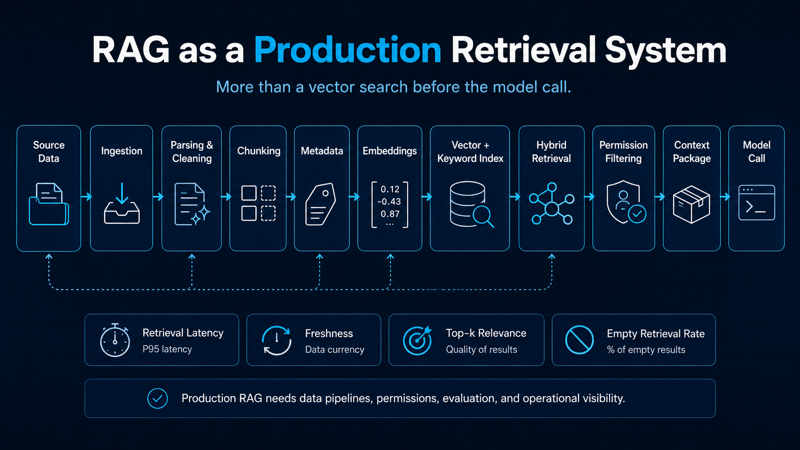
This matters because many AI quality issues are not actually model issues.
A poor answer may come from weak retrieval. The model may be working correctly, but the context may be incomplete, outdated, too broad, too narrow, or not filtered properly for the user’s permissions.
For production AI products, retrieval needs its own operational signals. Useful RAG metrics include:
- retrieval latency
- empty retrieval rate
- top-k relevance
- document freshness
- embedding version
- index update time
- re-ranking impact
- filtered or denied retrieval attempts
- answer citation quality
Without these signals, teams can see that the response is weak, but they cannot easily tell why.
Was the model wrong?
Was the prompt unclear?
Was the retrieved context weak?
Was the index stale?
Was the user blocked from the right data?
Was the wrong document version used?
A mature RAG architecture helps answer those questions.
4. Match Inference Architecture to Real Workload Behaviour
Production AI platforms rarely have a single inference pattern.
Some requests are interactive and latency-sensitive. Others can run asynchronously, use custom models, require GPU-backed inference, or need deeper runtime control.
On AWS, the decision is not only which model to use. It is also how that workload should be served, scaled, monitored, and operated.
Three common options are Amazon Bedrock, Amazon SageMaker, and Amazon EKS.
Amazon Bedrock
Amazon Bedrock is often a good fit when teams want managed access to foundation models without operating the underlying model infrastructure.
It is useful when the priority is:
- faster integration
- managed foundation model access
- lower infrastructure overhead
Amazon SageMaker
Amazon SageMaker is more relevant when custom model lifecycle management becomes important.
It is useful when teams need:
- model registry and approval workflows
- custom model deployment
- structured MLOps processes
Amazon EKS
Amazon EKS can be useful when teams need Kubernetes-native control over inference workloads.
It is relevant when the platform requires:
- custom inference stacks
- GPU scheduling
- autoscaling with workload-specific metrics
The important point is that production inference should be selected by workload behaviour, not familiarity.
A classification workflow may use a smaller and cheaper model. A reasoning-heavy workflow may need a stronger model. A document processing workflow may run asynchronously. A customer-facing chat experience may need lower latency and fallback routing.
Trying to serve all of these through one pattern can make the platform harder to scale, monitor, and optimise.
5. Version Everything That Can Change the Output
In traditional software systems, teams usually version application code and infrastructure.
In AI systems, that is not enough.
An AI output can change because of many different factors:
- model version
- prompt template
- system instruction
- retrieval configuration
- embedding model
- chunking strategy
- source data snapshot
- guardrail policy
- routing rule
- evaluation dataset
- output validation logic
If these are not versioned, debugging becomes difficult.
When a customer says, “the answer changed,” the team needs to know what changed.
Was it the model?
Was it the prompt?
Was it the retrieved context?
Was it the embedding version?
Was it a new document in the index?
Was it the guardrail policy?
Was it a routing change?
Was it the output validation layer?
A production AI release should not simply deploy “the latest prompt”.
It should promote a tested AI asset bundle.
For example:
AI release bundle:
Application version
+ Prompt version
+ Model configuration
+ Retrieval configuration
+ Embedding version
+ Evaluation results
+ Guardrail policy
+ Rollback target
This is where DevOps, MLOps, and platform engineering start to overlap.
The goal is not to slow down AI teams with unnecessary process. The goal is to make AI changes testable, traceable, and reversible.
For growing AI products, this becomes critical. Without versioning, teams may struggle to explain why output quality changed, why cost increased, or why one workflow started behaving differently after a release.
A production AI platform needs release discipline around every component that can affect behaviour.
6. Trace the Full AI Request Path, Not Just the App Health
Traditional observability tells teams whether the application is healthy.
AI observability needs to go further.
The application may be online, but the AI experience may still be degraded.
The model may respond successfully, but the answer may be weak. Retrieval may return results, but the context may be poor. The request may complete, but token usage may be too high. A workflow may work for one tenant, but fail for another because of permissions or data availability.
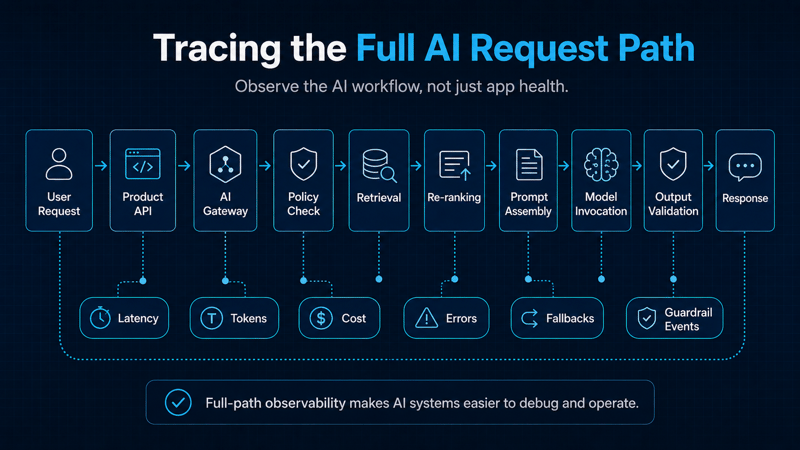
A production AI platform should trace the full request path:
User request
↓
Product API
↓
AI gateway
↓
Policy check
↓
Retrieval
↓
Re-ranking
↓
Prompt assembly
↓
Model invocation
↓
Output validation
↓
Response
Each stage should produce useful operational signals.
Important metrics include:
- end-to-end latency
- model latency
- retrieval latency
- orchestration step latency
- token usage
- cost per request
- timeout rate
- fallback rate
- guardrail intervention rate
- empty retrieval rate
- output validation failures
- user feedback
- model error rate
- tenant-level usage
This gives engineering teams a clearer way to debug production issues.
Instead of asking, “Why did the AI response fail?”, teams can ask more precise questions:
- Was the model slow or was retrieval slow?
- Did the request hit the right model route?
- Did the prompt version change?
- Did the retrieval layer return enough relevant context?
- Was the response blocked by a guardrail?
- Which tenant or workflow is driving token usage?
- Which model route has the highest timeout rate?
- Which workflow has the highest cost per successful response?
This is the difference between monitoring an application and operating an AI platform.
For AI product companies, full-path observability is not a nice-to-have. It is the foundation for reliability, quality improvement, cost control, and customer support.
7. Control AI Cost Before Growth Makes It Harder to See
AI platform cost is different from traditional cloud infrastructure cost.
It is not only compute, storage, and networking.
Cost can come from:
- input tokens
- output tokens
- embedding generation
- vector storage
- index refresh jobs
- model endpoints
- GPU nodes
- orchestration retries
- logs and traces
- evaluation runs
- batch processing
- idle environments
This means AI cost needs to be measured at the workflow level, not only at the AWS account level.
Useful cost views include:
- cost per support answer
- cost per generated report
- cost per document processed
- cost per tenant
- cost per model route
- cost per successful workflow
- cost per retrieval operation
This visibility directly affects architecture decisions.
A smaller model may be enough for classification. A stronger model may be needed for complex reasoning. Better retrieval may reduce prompt size. Caching may reduce repeated calls. Asynchronous processing may reduce pressure on interactive endpoints. Better model routing may reduce cost without reducing output quality.
Without this visibility, AI cost can grow quietly.
By the time the monthly bill becomes a problem, the team may not know which workflow, tenant, model route, or retrieval pattern is responsible.
Cost control should therefore be part of the production architecture from the beginning.
What a Production AI Platform on AWS Should Separate
A mature AI platform on AWS should separate the product experience from the platform responsibilities around it.
The product layer should stay focused on the user experience and application logic. The platform layer should handle model access, orchestration, retrieval, inference, observability, security, cost visibility, and delivery workflows.
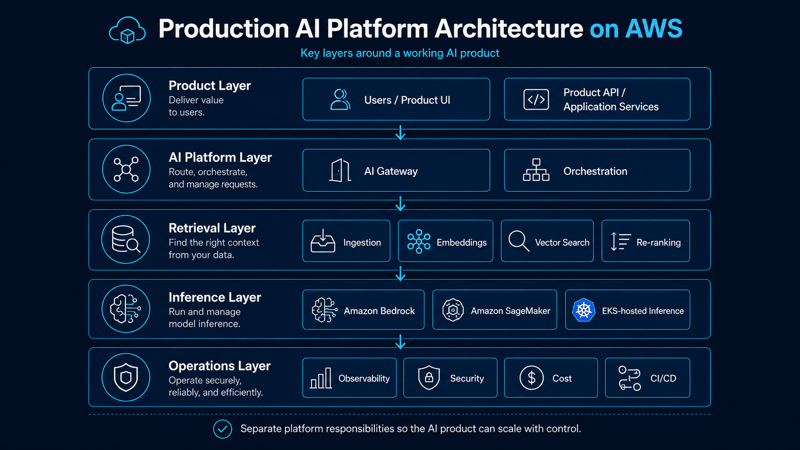
This structure is not about adding complexity for its own sake.
It is about making the AI platform easier to operate as the product grows. Each layer has a clear responsibility. Each layer can be monitored, tested, improved, and evolved without forcing every change through the product codebase.
For AI companies, this separation becomes increasingly important as more features, users, data sources, and customer expectations are added to the platform.
Production Readiness Checklist for AI Platforms on AWS
Before scaling a working AI product further, technical teams should review whether the platform is ready across six areas.
Platform Structure
- Is model access centralised?
- Are prompt logic, orchestration, and retrieval separated?
- Is there a rollback path for prompts, models, and retrieval changes?
Security
- Are model calls protected with least-privilege access?
- Are prompts and responses logged safely?
- Are retrieval permissions tenant-aware and supported by guardrails?
RAG and Data
- Is source data traceable?
- Are chunking, embeddings, and retrieval configuration versioned?
- Is retrieval quality measured?
Inference
- Are workloads separated by latency, volume, and cost profile?
- Is there a fallback route if a model is unavailable?
- Are scaling policies based on relevant AI workload metrics?
MLOps and Delivery
- Are prompts, models, retrieval configs, and guardrails versioned?
- Are evaluation results part of the release process?
- Is there a controlled promotion path from development to production?
Observability and Cost
- Can the team trace a request from user input to final response?
- Is token usage visible by tenant, workflow, or product area?
- Is cost measured per useful AI workflow?
Where Bion Fits
AI product teams are usually focused on product development, data science, model experimentation, and customer-facing features.
The production gap often sits around the platform layer.
That includes AWS architecture, model deployment patterns, RAG infrastructure, Kubernetes-based inference, CI/CD workflows, security controls, observability, MLOps, cost visibility, and day-to-day operations.
This is where Bion helps AI-driven companies on AWS.
We support teams that already have a working AI product and need to mature the platform around it. That may include restructuring the AWS architecture, improving model access patterns, building more reliable RAG pipelines, deploying LLM workloads, setting up observability, introducing MLOps workflows, or strengthening operational control.
The goal is not to slow AI teams down.
The goal is to give them a production structure that supports faster delivery, safer scaling, clearer visibility, and better control as the product grows.
For more detail, explore our related services:
- AI Platform Architecture and Implementation on AWS
- Generative AI and LLM Deployment on AWS
- AI Platform Operations and MLOps on AWS
Conclusion
A working AI product is an important milestone.
But as the product grows, the platform around it needs to mature.
Model access needs to be controlled. RAG needs to become a measurable retrieval system. Inference needs to match real workload behaviour. Prompts, models, embeddings, retrieval settings, and guardrails need versioning. Observability needs to follow the full AI request path. Cost needs to be tracked at the workflow level.
On AWS, the building blocks are available.
The challenge is structuring them into a platform that can support real product growth.
For AI companies moving beyond the first working product, this is where platform architecture becomes critical. It gives engineering teams the structure they need to scale reliably, operate with confidence, and keep improving the AI experience without losing control of the system behind it.
Already have a working AI product on AWS, but need a stronger production platform around it?
Bion helps AI-driven teams structure the AWS platform layer needed for scale, reliability, observability, secure model access, RAG operations, MLOps, and controlled delivery.
Book a technical strategy call to review where your AI platform needs to mature next.