
Real Scenarios from Production Teams
Most teams don’t start with DevOps as a Service.
They arrive there.
Not because they lack engineers, but because the platform they are running becomes harder to operate, scale, and keep stable.
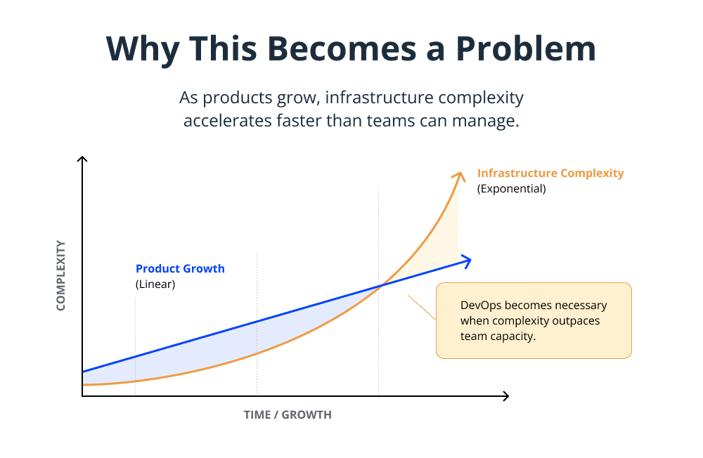
In early stages, infrastructure is manageable.
- a few services
- simple pipelines
- limited environments
As the product grows:
- environments multiply
- deployments become more frequent
- systems become interdependent
At that point, DevOps is no longer a side responsibility. It becomes a bottleneck.
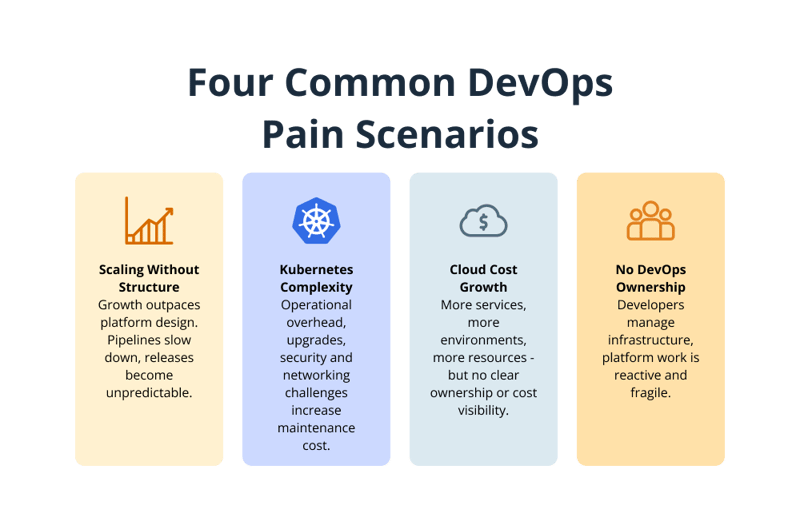
Scenario 1: Scaling a Product Without Platform Structure
A common pattern:
- engineering team grows quickly
- features are prioritised over platform design
- infrastructure evolves without clear standards
What starts to happen:
- CI/CD pipelines slow down
- environments drift
- releases become harder to predict
We have seen this across SaaS and digital platforms where growth outpaces platform structure.
What is needed is not more code — but:
- consistent deployment workflows
- standardised environments
- infrastructure defined and managed properly
Scenario 2: Kubernetes Introduces More Complexity Than Expected
Teams adopt Kubernetes expecting flexibility.
They get:
- operational overhead
- upgrade and versioning challenges
- security and networking complexity
Clusters that initially work well become harder to maintain over time.
We have seen this in environments running:
- high-traffic platforms
- AI workloads on EKS
- multi-environment Kubernetes setups
What is required is not just Kubernetes knowledge, but:
- lifecycle management
- scaling strategies
- operational discipline
Scenario 3: Cloud Costs Increase Without Clear Ownership
As systems scale:
- more services are deployed
- more environments are created
- more resources are provisioned
But often:
- no clear ownership model exists
- cost visibility is limited
- optimisation is reactive
Teams notice the increase, but not the cause.
In these cases, the problem is not AWS itself — it is how the platform is structured and operated.
Scenario 4: No Dedicated DevOps Capability
In many growing teams:
- developers manage infrastructure
- DevOps is postponed
- platform work is done reactively
This works until:
- deployments slow down
- incidents increase
- systems become fragile
At that point, internal capacity is not enough to stabilise the platform quickly.
Why Hiring Alone Doesn’t Solve It
Hiring DevOps engineers sounds like the natural solution.
In reality:
- hiring takes time
- onboarding takes longer
- knowledge builds slowly
Meanwhile:
- systems continue to grow
- issues accumulate
- delivery slows down
The gap between what is needed and what is available becomes wider.
A Different Model: Flexible DevOps Capacity
In practice, DevOps needs are not constant.
They change depending on the phase:
- platform build
- migration
- production rollout
- ongoing operations
A fixed team does not always match this pattern.
A DevOps-as-a-Service model allows:
- scaling up during critical phases
- reducing involvement once systems stabilise
- maintaining continuity without restarting the process
This avoids both over-hiring and under-capacity.
Experience That Shortens the Learning Curve
Infrastructure decisions are rarely simple.
Choices around:
- cloud architecture
- Kubernetes design
- CI/CD workflows
- scaling strategies
have long-term impact.
We have worked across hundreds of projects and production environments — from AI-driven platforms to fintech systems, SaaS products, and healthcare applications.
This exposure changes how decisions are made:
- fewer trial-and-error cycles
- fewer architectural mistakes
- faster path to a stable system
Experience reduces iteration.
What DevOps as a Service Actually Involves
In production environments, this is not ad-hoc support.
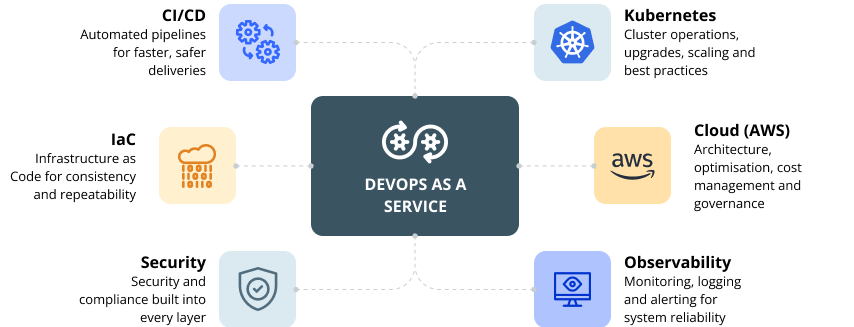
It typically includes:
- designing and implementing CI/CD pipelines
- infrastructure as code and environment standardisation
- Kubernetes operations and lifecycle management
- cloud architecture improvements
- observability and monitoring integration
- ongoing platform support
The goal is not just to build, but to keep the platform stable as it evolves.
When It Makes Sense
DevOps as a Service becomes relevant when:
- systems are scaling faster than the platform can support
- infrastructure complexity starts affecting delivery
- reliability becomes harder to maintain
- internal capacity is not enough to stabilise and evolve the platform
It is not a starting point. It is a response to real operational pressure.
How Bion Works
At Bion, we work as a hands-on engineering partner.
We design, implement, and operate cloud and platform infrastructure across AWS and Kubernetes environments — supporting teams through platform build, production rollout, and ongoing operations.
Explore Further
- DevOps as a Service
- AWS DevOps Consulting
- Kubernetes Managed Services
- Real-world implementations across cloud, Kubernetes, and AI platforms
If you are reviewing how DevOps is structured in your environment, it is usually a signal that something in the platform needs to change.